While in Congress, and until the pandemic, I would visit SCI Graterford (now SCI Phoenix) each Veterans Day, spending time with its incarcerated veterans — many of them African American, given its proximity to Philadelphia — and their families.
The veterans initiated a formal ceremony during those visits.
The first time it happened, a small group hummed the “Battle Hymn of the Republic” as about 200 veterans, each called by name, walked up, turned, and stood at attention. As the last name was called and the hymn ended, there was a moment of silence, when everyone was uncertain about what to do next.
Suddenly, a large group of nonveteran prisoners who had been watching stood up and clapped.
The pride I saw on the veterans’ faces that day mirrors what the annual Arlington National Cemetery’s Veterans Day ceremony means for our nation.
But Veterans Day became less inclusive this year.
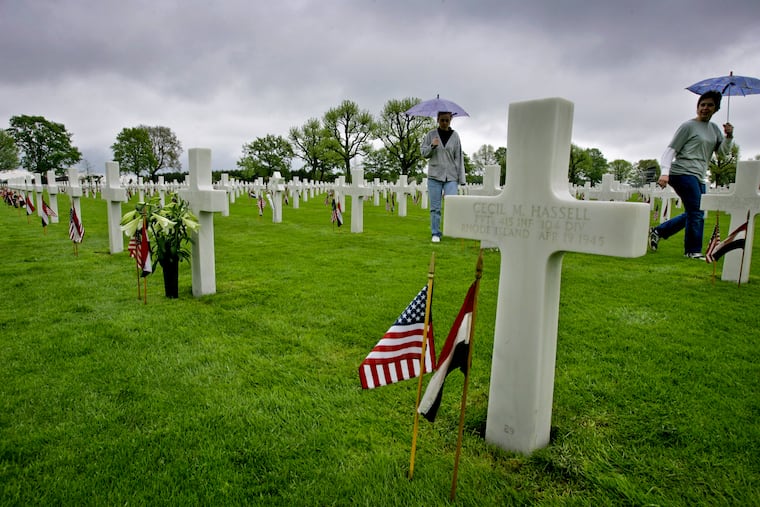
Dutch media reported that a pair of World War II memorial plaques at the Netherlands American Cemetery and Memorial in the town of Margraten were removed by the American Battle Monuments Commission.
Commemorating the 172 African American soldiers buried there, the metal tablets were meant to be an enduring tribute to a group of Americans who were never to come home. The quiet removal of this part of the memorial caused some fury because the Dutch — knowing Black service members had been a crucial part of liberation from Nazi occupation — had initiated this recognition of their valor.
When the news of the removal broke, I was speaking at the U.S. Naval Academy (of which I am an alumnus), answering questions about what it’s like to be a “sailor in politics” — including the lasting significance of the academy’s mission to imbue midshipmen with the “highest ideal of honor.”
I mentioned the honor President Donald Trump did in referencing the Book of Exodus on the first day of Passover this year, when he noted, “Every year at this time, Jewish families celebrate God’s liberation of the ancient Israelites from slavery. …” The president also recognized the “strength of the Jewish people” in the face of 1,832 anti-Jewish hate crimes recorded by the FBI in 2023 against their ethnicity.
In stark contrast, the week before Passover, our government ordered the removal of all books at the U.S. Naval Academy that gave any recognition to the historical enslavement of Black people in America, or the racism they’ve confronted since. In 2023, the FBI recorded 3,027 hate crimes against Black people in our nation.
The need for us to remain “on watch” about the substance of these FBI stats is evident today, when the Navy’s sister maritime service, the U.S. Coast Guard, reversed its recent decision to declassify symbols of the persecution of both Jewish and Black Americans — the swastika and noose — as “hate symbols” after it became public.
It’s why, for me, America’s government decision to ban books that honor the end of slavery by President Abraham Lincoln — as well as books chronicling the enduring strength of African Americans who still experience discrimination as their Jewish brethren do — is like banning the Book of Exodus.
So, in my comments at the Naval Academy, I recounted for the midshipmen that when I ran for U.S. Senate in 2010, I, too, had been banned.
The “party boss” of Philadelphia had called to let me know I couldn’t attend any Democratic gatherings in the city because, he explained, the president and vice president, along with Pennsylvania’s top political leaders, had endorsed my opponent.
Instead of going to those gatherings, I visited more than 200 African American churches, knowing of the appreciation in those congregations for what the military had offered in the decades after World War II — a place where Black youth were assured equal pay and healthcare, with training and education, along with a pension for those who stayed in.
Not perfect in all regards, assuredly. But it’s why when every church’s pastor inevitably asked: “Is anyone new here? Please introduce yourself,” I’d stand and say: “I’m Joe Sestak, a congressman outside of Philadelphia, now running for Senate. But my real service to my country was in the U.S. Navy, where I learned the meaning of what Isaiah said to God when the Lord asked, “Who will go for us; who will I send?”
Not once did I need to give Isaiah’s reply, as each congregation called out, “Here am I; send me.”
Years later, over breakfast, the party boss said he couldn’t understand why the turnout in the city’s predominantly Black wards was the highest anyone had ever seen for an “off-year election.”
Veterans Day became less inclusive this year.
There are numerous veteran plaques, memorials, and books dedicated to so many people from so many ethnic groups in America, as they should be — the military is the greatest of American mosaics: every culture, religion, race, gender (until the U.S. Supreme Court upheld President Trump’s transgender military ban), rural, urban, socioeconomic level, political persuasion, etc., come together in working units.
I used to end each Veterans Day, at night, at a gathering of the Ancient Order of Hibernians, the nation’s oldest organization of Irish American Catholics. There, I would relate a Jewish teaching about two friends who sailed from the land of Israel centuries ago. In a foreign land, one was arrested as a spy. Sentenced to hang, he asked if he could return home to embrace his family one last time while his friend stayed in jail to ensure his return.
The judge agreed, but the accused man was late returning due to a storm at sea. Running off the gangplank, he saw they were just about to hang his friend, and he called out, “Stop, I’m the one to be hung.” But his friend called back: “No. You are too late. I will hang.” They argued until the king overheard them and demanded to see them. He listened to each argue for himself to be the one to hang, then called out: “Stop. I will forgive you both under one condition. That you two make me your third friend.”
That’s what it’s like in the military. Each warrior, each veteran is a third friend.
I experienced this one evening in Iowa when I was running for president, and my mobile rang. It was one of the Graterford veterans to whom I had given my phone number. I won’t ever forget his low, gravelly voice as he said: “Joe, the guys have heard … you’re running for president … and they want you to know … we’re going to organize Philadelphia for you.”
Those incarcerated veterans still had that sense of possibility, the feeling they could do something for their country — because of their shared American story of having once worn the cloth of our nation.
President Trump, our commander in chief, shouldn’t allow the ultimate sacrifice that’s been made by any American to be forgotten or ignored. It is our solemn duty to put those plaques and books back where they belong — at the final resting place of a group of brave Americans who died far from home, and also where our future warriors are being trained.
We must offer honor where honor is due — and we should do so before another Veterans Day passes.
To honor veterans, put the plaques and the books back


RELATED ARTICLES