

Deportation Inc.
THE MILITARY SUPPLIERS BEHIND IMMIGRATION RAIDS
Some Defense Department companies are collecting record contracts by outfitting Trump’s crackdown.
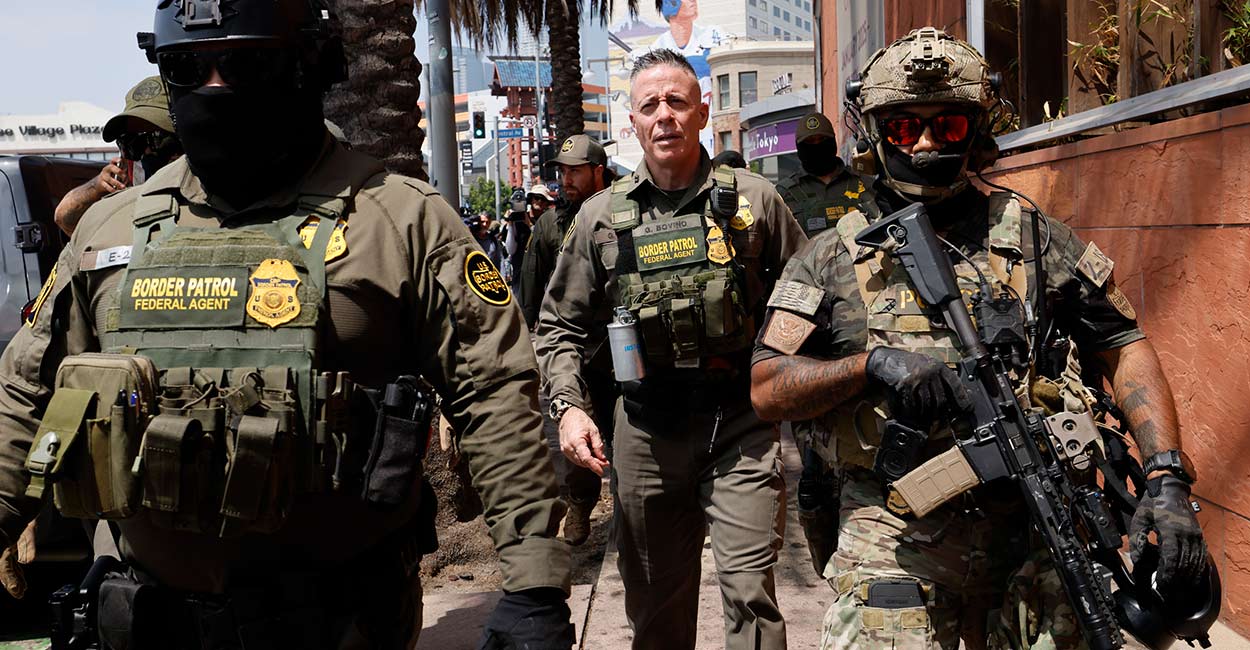
Gregory Bovino, a Border Patrol commander, and other agents in Los Angeles in August. Photo illustration: 731; Photograph: Getty Images
Some companies are securing record contracts by outfitting Trump’s crackdown.
Share this article
In the final weeks of the 2025 fiscal year, the Trump administration’s immigration enforcement agencies went on a spending spree to outfit officers as they fanned out across American cities: $12.2 million for rifles, $11.3 million on tasers and $3.7 million worth of chemical munitions and less lethal materiel.
Those were among a slew of weapons, ammunition and protective equipment made or sold by companies that have seen a huge spike in revenue from the Department of Homeland Security, including several that usually sell their products to the military.
Take Geissele Automatics, a Pennsylvania-based weapons manufacturer that contracts with both the Department of Defense and DHS. It agreed to sell $9.1 million of precision long guns and accessories to Immigration and Customs Enforcement and $3.1 million of rifles to Customs and Border Protection in September – two of the company’s biggest ever deals with the federal government. (Geissele Automatics founder William Geissele declined to comment, citing a nondisclosure agreement.)
That same month, as the Trump administration started focusing its immigration crackdown on Chicago, ICE agreed to spend a total of almost $140 million on weapons, ammunition and other equipment for their officers. Of that, more than $7 million was designated for training purposes to support the massive hiring surge the administration has promised. CBP put in orders for another $65 million worth of such gear, ranging from uniforms to gas masks and body armor.
The result has been on full view in Chicago’s neighborhoods and other cities across the country, where armed and masked officers from federal law enforcement agencies have been arresting immigrants and citizens alike, shooting protesters with pepper balls and tossing canisters of tear gas into crowds.
The militarization of the police in the US is nothing new. Local police departments splurged on vehicles, weapons and tactical gear as part of the Nixon, Reagan and Clinton administrations’ fight against drugs and the Bush administration’s war on terror after the 9/11 attacks.
But the size of those buildups is dwarfed by President Donald Trump’s push to vastly expand immigration arrests and make Democratic-run cities a proving ground for domestic military operations. His One Big Beautiful Bill Act allocated $171 billion to immigration and border work, including $30 billion for enforcement and removal over four years. On an annual basis, the new funding to ICE nearly tripled the agency’s budget from the previous year.
DHS, ICE and CBP didn’t provide comment for this article.
Outfitting immigration agents like soldiers to this degree is unprecedented, said César Cuauhtémoc García Hernández, a law professor at Ohio State University focused on immigration.
ICE’s stock of military gear is usually reserved for major one-off raids. That it’s now a common sight on American streets is “reflective of the fact that Congress has opened up its wallet,” Hernández said. “They’re popping tear gas canisters with abandon, which suggests they have every reason to believe they can replace those pretty quickly.”
From Trump’s return to the White House through mid-November, CBP ordered at least $6.8 million worth of less lethal equipment such as tear gas and pepper balls – a 139% increase from the equivalent period a year earlier.
In October, a US district court judge in Illinois ordered federal immigration officers to limit their use of force, including tear gas and pepper balls, against peaceful protesters, journalists and others. The order was in response to a lawsuit from news outlets and protesters alleging excessive force by federal agents, including border patrol commander Gregory Bovino. In a deposition, Bovino admitted that he lied when he said he only threw a tear gas canister at protesters after being struck by a rock.
A subsequent opinion by the same judge revealed more information from body cameras that showed officers used tear gas on fleeing protesters, drove aggressively in an apparent attempt to create conditions for further use of force, and pointed guns at bystanders filming incidents. A spokesperson for PepperBall, which sells its guns to CBP through Advance Tactical Ordnance Systems, said they “believe that every law enforcement situation is better off when non-lethal tools like ours are available and properly used.”
Most of the highly visible incidents of federal officers using aggressive tactics have involved border patrol agents. Hernández said this isn’t surprising considering their history of behavior near the border. Until now, those agents have “largely been left to operate on their own with very little oversight,” he said, in part because there’s less attention on what happens in small border towns.
The Trump administration has defended the behavior of its immigration officers, who’ve routinely shoved, shot and gassed people over the past several months, saying that threats against federal law enforcement are skyrocketing.
“We’re not backing down, we will keep going, we will continue to enforce the rule of law,” DHS spokesperson Tricia McLaughlin said in an October interview on Fox News. President Trump and DHS Secretary Kristi Noem “are going to give our law enforcement the resources they need to succeed and clean up America’s streets.”
The increased spending on weapons and equipment indicates that ICE is “enhancing its SRT,” or special response teams, which are specially trained for high risk operations, said John Tsoukaris, former Newark ICE field office director who retired earlier this year.
“SRTs are similar to SWAT teams local police departments have,” said Tsoukaris, who now runs JTS Advisors, an immigration consultancy. Members of ICE’s SRT teams are required to go through significantly more training than a typical officer, he said, adding that the administration is likely increasing their deployment because it sees a greater threat to officers in the field. Of the $140 million ICE spent on weapons and other equipment, roughly $55 million of it was earmarked for ICE’s Office of Firearms and Tactical Programs at Fort Benning in Georgia that has been used to train ICE officers.
To help carry out its mass deportation effort, the Trump administration has folded in a number of other federal law enforcement officers, including from border patrol. One of the groups that’s been active in major US cities like Chicago is a tactical unit called BORTAC, which is border patrol’s SRT equivalent. Its officers can be seen wearing full army fatigues, gas masks and ballistic helmets, with large weapons strapped around their bodies.
“The appearance of BORTAC in these crowd control operations and the like does represent a significant intensification or militarization of operations against people who are not a threat,” said Stuart Schrader, associate professor of history at Johns Hopkins University and author of Badges Without Borders: How Global Counterinsurgency Transformed American Policing. “All of this is extremely dangerous, and it’s lucrative for the weapons manufacturers too.”
— With assistance from Alicia A. Caldwell and Irene Casado Sanchez.
Methodology:
Bloomberg identified weapons and gear contracts using the BGOV Market filter on Bloomberg Government. Reporters then reviewed other large ICE and CBP transactions, and identified two additional relevant task orders, one for $10 million to Quantico Tactical for firearms and magazines and one for $15.5 million to Lionheart Alliance for ballistic helmets. To determine how much CBP spent on less lethal weapons, we identified transactions from Jan. 20, 2025 to Nov. 15 that have
Military Suppliers Are Cashing in on ICE, Immigration Raids


RELATED ARTICLES

