


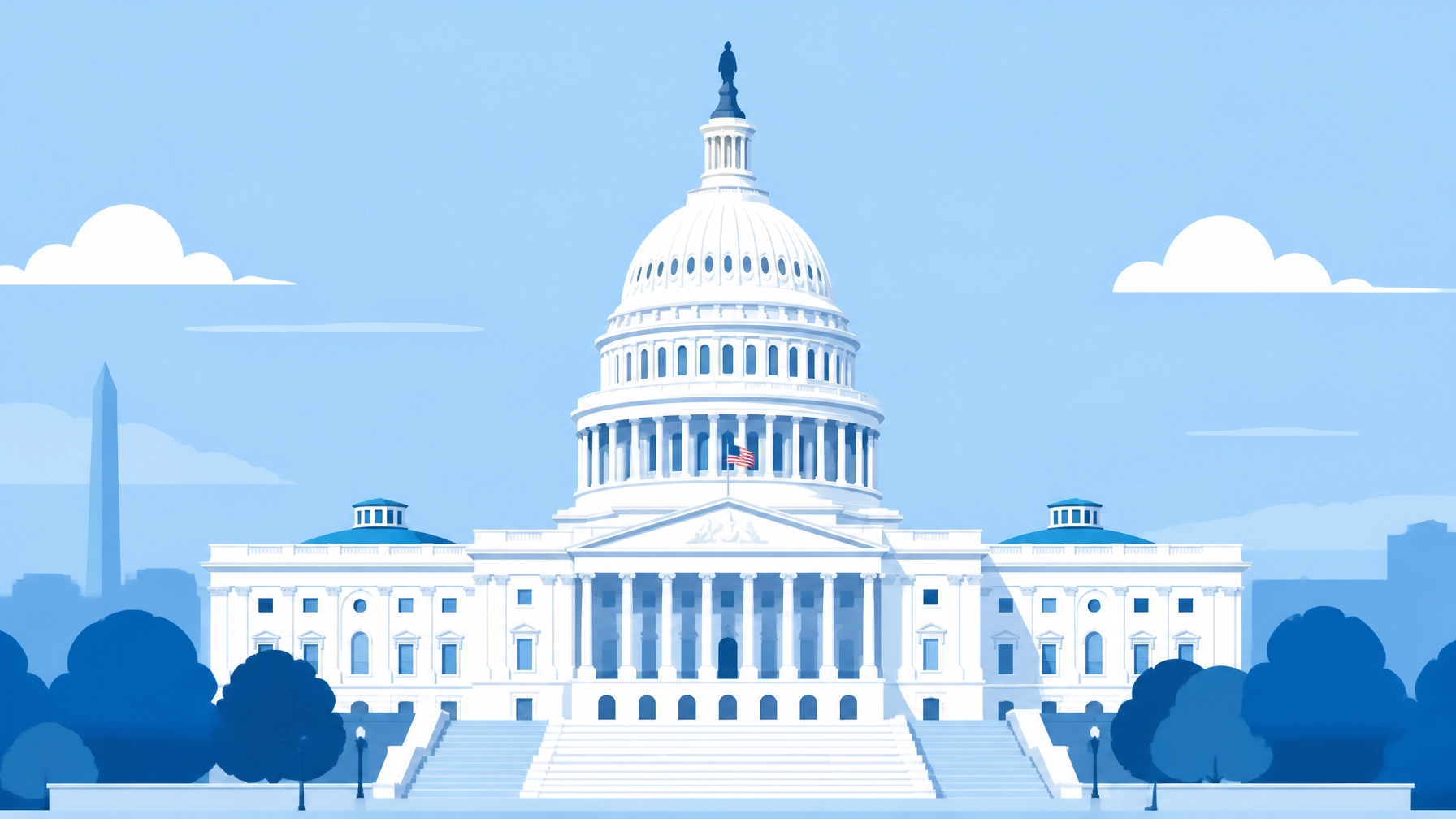
A comprehensive look at the Trump-Vance administration, a divided Congress, and the institutional forces shaping American governance in 2026.
In July 2026, the United States continues to operate under a Republican administration led by President Donald Trump and Vice President J.D. Vance. The political landscape is characterized by a polarized Congress, assertive executive actions, and ongoing disputes regarding immigration, federal budgeting, and the authority of federal agencies. While formal democratic institutions remain in place, they face significant pressure from deep partisanship and institutional conflict.
Executive Branch: The Trump–Vance Administration

The federal executive branch is currently led by President Donald Trump, following his victory in the 2024 election, alongside Vice President J.D. Vance. The administration has focused its efforts on a policy agenda centered on immigration enforcement, domestic energy production, and national defense. Due to frequent gridlock in Congress, the administration has relied heavily on executive orders and regulatory adjustments to implement its priorities.
Policy analyses of the Washington environment for 2025 and 2026 indicate that the executive branch has significantly expanded its influence. The administration has taken steps to cancel previously appropriated federal spending and has moved to reorganize various departments within the federal bureaucracy. Additionally, the White House has authorized several military actions abroad without extensive legislative consultation. These moves have sparked ongoing legal and political debates regarding whether executive power has begun to overshadow the traditional lawmaking role of Congress.
The administration’s "America First" approach has also influenced international trade and diplomatic relations. This shift has led to the renegotiation of several multilateral agreements and a renewed focus on bilateral trade deals. Observers note that these executive-led initiatives are designed to bypass the slower legislative process, though they often face challenges in federal courts. For more updates on executive actions, readers can visit the USGov.News articles page.
Congress: Divided, Gridlocked, and Relatively Inactive

The 119th Congress continues to handle basic legislative duties, such as passing appropriations, but it remains less productive than previous sessions. A primary legislative achievement of the current majority is the "One Big Beautiful Bill Act": a comprehensive package that combined tax cuts, increased defense spending, stricter immigration enforcement, and expanded energy development.
Despite the passage of this major bill, the overall legislative output is notably low. Fewer than 40 bills were enacted during the previous year. This pace suggests that the 119th Congress may be among the least active in the early years of a modern presidency. Republicans currently hold key leadership positions and have utilized budget reconciliation procedures to advance priority measures. This tactic allows for the passage of certain financial and health care policies with a simple majority in the Senate, avoiding the 60-vote threshold.
Intraparty divisions within the Republican majority and consistent Democratic opposition have made large-scale bipartisan legislation difficult to achieve. This environment has reinforced a pattern where the President utilizes executive authority to advance policy goals. Congressional committees have remained active in oversight roles, particularly regarding the administration's use of executive orders and the reorganization of federal agencies. Citizens looking to track these developments can subscribe to our daily political newsletter.
Federal Government Funding and Shutdowns

Budgetary disputes, primarily focused on immigration enforcement, have resulted in a new form of government shutdown in 2026. In February, disagreements over reforms to Immigration and Customs Enforcement (ICE) and Customs and Border Protection (CBP) led to a legislative impasse. Congress tied the funding for the Department of Homeland Security (DHS) to specific reform negotiations following several high-profile incidents.
When a compromise was not reached by the February deadline, DHS entered a partial shutdown. Under this specific arrangement, essential DHS functions: including emergency response and select border security operations: continued without immediate pay for personnel. Conversely, nonessential activities were suspended, and thousands of employees were placed on furlough. Because the funding dispute was isolated to DHS, other federal departments remained open and fully operational.
This focused shutdown model illustrates the intense nature of modern immigration debates. Multiple shutdown episodes have occurred in 2026, each linked to border policy and internal agency reforms. These events underscore the frequency of institutional brinkmanship between the legislative and executive branches. The impact on government contractors in the security sector has been significant, as many projects faced delays during the DHS-specific funding gaps.
States and Divided Government at the Subnational Level

At the state level, political control is varied but currently leans toward the Republican Party. In 2026, there are 28 state legislatures under full Republican control and 18 under full Democratic control. Four states maintain split control between the two parties. While many states are holding legislative elections this year, the balance of power has remained relatively stable since 2025.
The current map of state control has allowed conservative policy agendas to gain momentum in more than half of the country. These priorities typically include tax reductions, regulatory streamlining, and criminal justice reforms. In contrast, Democratic-led states have prioritized climate change initiatives, voting rights expansions, and various social safety net policies.
This divide at the subnational level plays a critical role in how federal initiatives are implemented. State governments serve as essential partners in the administration of health care, education, and infrastructure projects. The divergence in state-level policies has created a "patchwork" effect across the nation, where the legal and regulatory environment for businesses and citizens can change significantly across state lines. To learn more about our coverage of these issues, visit the About Us section.
Public Opinion and the State of the Union Mood

Recent survey data from early 2026 indicates that the American public remains skeptical of economic conditions and divided on the administration's performance. A clear majority of citizens describe national economic conditions as "fair" or "poor," with only a minority rating them as "excellent" or "good." Furthermore, more respondents believe that current presidential policies have hindered the economy rather than helped it.
Economic concerns are primarily driven by the rising costs of health care, housing, and consumer goods. Despite the partisan divide, a majority of Americans believe the federal government holds a responsibility to ensure health care coverage for all citizens. On the topic of immigration, public sentiment is nuanced: most people favor a strong security presence at the U.S.–Mexico border but oppose profiling based on appearance or language.
Energy policy remains a point of interest for the electorate. Support for expanding solar and wind power is high, although it has seen a slight decline since 2020. Conversely, support for nuclear power has grown among both Republicans and Democrats. These trends reflect a public that desires both economic security and social protections, even as they disagree on the specific federal methods to achieve them.
Democracy and the Rule of Law
Assessments of American democracy in 2026 by independent observers indicate that while core criteria for electoral competition and civil liberties are being met, the system is under notable pressure. Partisan polarization and disputes over election procedures continue to generate tension. The Trump–Vance administration has promoted a vision of more centralized executive authority and a fundamental reshaping of regulatory priorities.
The federal courts and various civil society organizations have continued to challenge the administration's agenda. No single branch of government has formally exceeded its constitutional boundaries, but the balance between executive action and legislative oversight remains a point of contention. Frequent budget standoffs and agency-specific shutdowns have raised questions about the long-term governance capacity of the federal system.
Election integrity remains a central topic as the 2026 midterms approach. Both parties have focused on legislative efforts at the state level to adjust voting rules and oversight mechanisms. These debates regarding the "state of democracy" are expected to be a defining feature of the upcoming election cycle.
The Overall Picture
The current state of the United States government in 2026 is defined by several key factors:
- Assertive Executive Power: A presidency that leans heavily on executive orders and the reorganization of the federal bureaucracy.
- Legislative Gridlock: A Congress that struggles to move bipartisan legislation, focusing instead on infrequent but massive partisan packages.
- Focused Funding Crises: The emergence of agency-specific shutdowns, particularly within the Department of Homeland Security, as a tool for political leverage.
- State-Level Divergence: A stable but polarized map of state governments that creates vastly different policy environments across the country.
- Public Dissatisfaction: A citizenry that is deeply divided and remains skeptical of national economic progress and institutional effectiveness.
In summary, the institutions of the federal government are operational, and the constitutional process continues. However, the system faces persistent stress from internal conflict and a decreasing capacity for legislative compromise. The 2026 midterm elections will serve as the next major indicator of whether these trends will continue or shift toward a different model of governance.
Mark Ricci is a senior political correspondent covering federal governance, policy, and institutional affairs for USGov.News.


