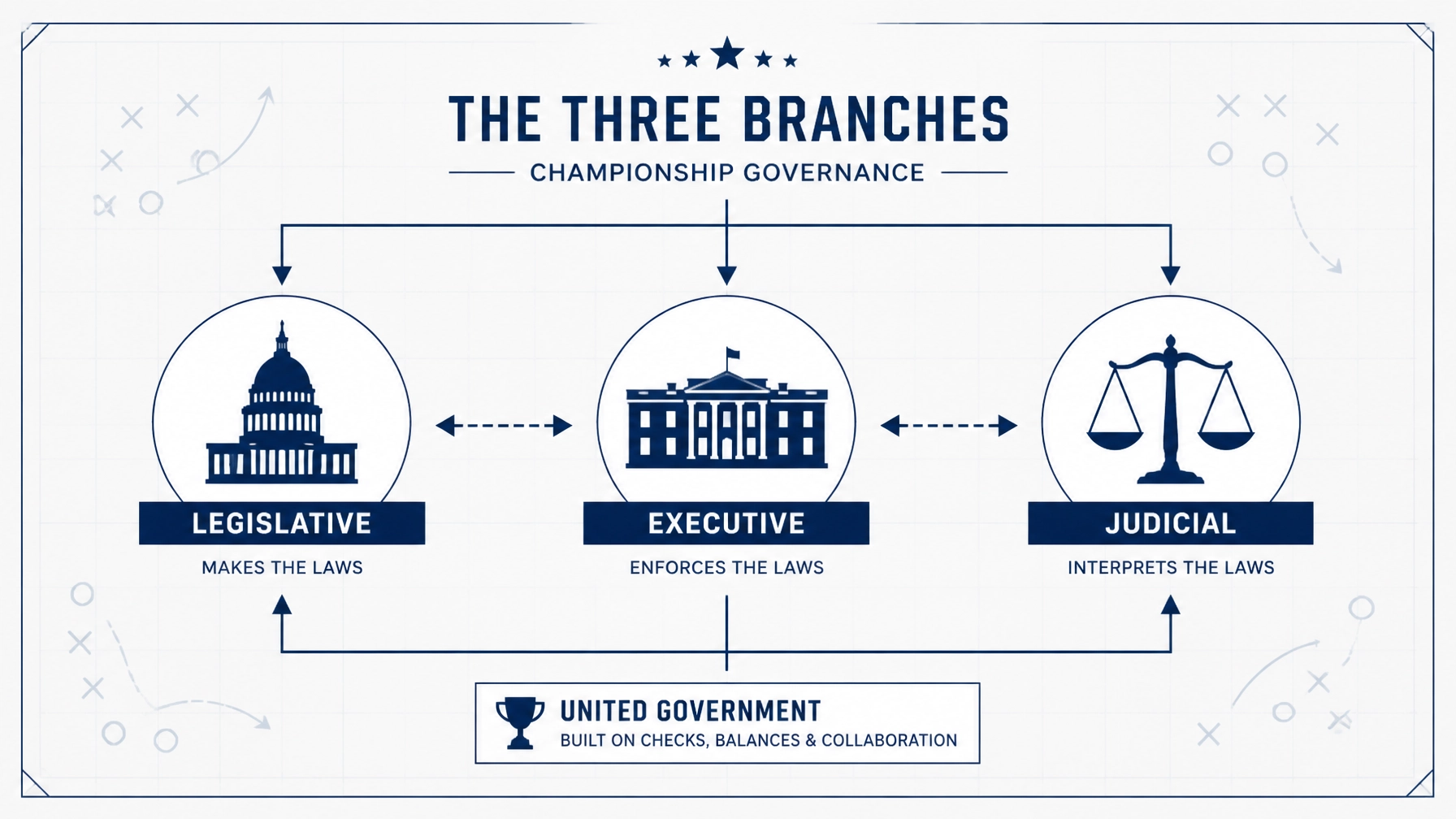
From the Articles of Confederation to the modern federal system, tracing the institutional playbook that built American governance.
By Mark Ricci
July 17, 2026
The structural framework of the United States government has undergone a profound transformation since the nation's founding, evolving from a loose confederation of independent states into a high-powered federal system. This evolution reflects the ongoing tension between centralized authority and state autonomy: a dynamic similar to a league office managing its franchise owners. For citizens and businesses tracking government articles, understanding this institutional growth is essential to navigating today’s political landscape.
Foundations: Independence and the Articles of Confederation
The United States achieved independent governance with the Lee Resolution and the Declaration of Independence in July 1776. Following the break from the British "league," the newly formed states operated under the Articles of Confederation. Approved by the Continental Congress on November 15, 1777, and ratified by the states in 1781, this document served as the nation’s first official playbook.
However, the Articles established what was essentially a "firm league of friendship" among the states, vesting most of the power in a unicameral Congress. This early system proved to be a flawed founding roster: the national government lacked a central "commissioner" (executive) and a "league umpire" (judicial branch). While the central government could conduct diplomacy, make war, and manage relations with Native Americans, it could not raise its own capital. It was entirely dependent on the states for funding, much like a sports league that could not collect its own television revenue.

Crucially, the Articles required unanimous approval from all 13 states for any amendment: a rule that made it impossible to update the playbook. The lack of power to tax or regulate interstate commerce led to a government that was frequently paralyzed. The ineffectual response to Shays' Rebellion in Massachusetts finally convinced the "front office" of national leaders that a more powerful central structure was necessary to maintain order and economic stability.
The Constitutional Revolution of 1787
By May 1787, it was clear that the Articles of Confederation were not built for long-term championship success. Delegates from 12 of the 13 states convened in Philadelphia to redesign the American system of government. While their original mandate was to revise the existing Articles, they instead chose to draft an entirely new Constitution, signed on September 17, 1787.

This "rebranding" created the first modern federal system, establishing a government with three distinct branches: legislative, executive, and judicial. The framers sought to create a government with enough power to act on a national level, but without so much power that individual franchise (state) rights would be at risk. They achieved this through a system of checks and balances: institutional oversight that ensured no single branch could dominate the league.
A key strategic move was the Great Compromise (also called the Connecticut Compromise). This established a bicameral Congress: the House of Representatives would represent the people based on population, while the Senate would represent the states equally. This balanced the interests of large and small "market" states, ensuring broad buy-in for the new national structure.
Ratification and the Bill of Rights
The ratification process sparked intense debate between two primary camps: the Federalists, who supported the new constitutional playbook, and the Anti-Federalists, who feared that a strong central government would trample individual liberties. Delaware became the first state to ratify on December 7, 1787. After New Hampshire became the ninth state to approve the document on June 22, 1788, the Confederation Congress set March 4, 1789, as the date to begin operating under the new Constitution.
Many states initially refused to sign the "contract" due to the lack of a clear Bill of Rights. In response, James Madison introduced 12 amendments to the First Congress in 1789. Ten of these were ratified as the Bill of Rights, protecting fundamental freedoms like speech, religion, and the press. These protections serve as the "basic player rights" in the American system, ensuring that the government's power is always balanced against individual autonomy. For regular updates on these ongoing constitutional developments, readers can subscribe to the USGov.News newsletter.
The Evolution of Federalism
The relationship between federal and state governments, known as federalism, has shifted dramatically over the centuries. In the early days, the nation operated under "dual federalism," often called "layer:cake federalism." In this model, the states and the national government exercised exclusive authority in their respective spheres: national defense for the federal government and local policing or education for the states.

In the 20th century, this gave way to "cooperative federalism," or "marble-cake federalism." This phase saw the federal government become more involved in traditionally state domains through grant programs and regulatory standards. Major periods of expansion in federal power include:
- The Civil War and Reconstruction (1860s): The federal government asserted supremacy over states' rights, particularly regarding citizenship and individual rights.
- The New Deal (1930s): In response to the Great Depression, the "central league office" dramatically expanded its role in economic regulation and social welfare.
- The Civil Rights Era (1950s:1960s): Federal intervention protected civil rights against state-level discrimination, enforcing a national standard for all citizens.
- Post:9/11 Era: National security concerns led to expanded federal authority in surveillance, immigration, and law enforcement.
Institutional Development
The growth of the three branches has shaped how government press releases and policy updates are handled today.
The Legislative Branch
Congress began as a bicameral legislature intended to be the most powerful branch. Over time, it has evolved into a complex institution with professional staff and significant policy-making authority. The Speaker of the House and the Senate Majority Leader have become key figures, often wielding influence comparable to that of the executive branch.
The Executive Branch
The presidency has grown from a relatively limited office into the most powerful position in American government. Early presidents operated with small staffs. The modern presidency, however, includes the Executive Office of the President and thousands of federal agencies. Today’s presidents set the national agenda and manage the sprawling "administrative state."
The Judicial Branch
The Supreme Court has evolved from a relatively weak institution into the final arbiter of constitutional questions. The power of judicial review, established in Marbury v. Madison (1803), allows the Court to strike down laws that violate the Constitution. This role is the ultimate "replay booth," ensuring that all legislative and executive actions follow the established rules of the playbook.
Constitutional Amendments and Adaptation
The founders built an amendment process into the Constitution to allow for rule changes as the nation grew. Since ratification, it has been amended 27 times. Major updates include:
- 13th:15th Amendments (1865:1870): Abolished slavery and established national citizenship.
- 16th Amendment (1913): Authorized federal income tax: the ultimate revenue stream for national expansion.
- 19th Amendment (1920): Granted women the right to vote.
- 22nd Amendment (1951): Limited presidents to two terms.
- 26th Amendment (1971): Lowered the voting age to 18.
These amendments demonstrate the Constitution's capacity for adaptation while maintaining structural continuity: the "rules of the game" can evolve without dismantling the entire league.
Contemporary Challenges
Today's federal government faces challenges that the founders could not have anticipated. The administrative state now manages global interdependence, climate change, and rapid technological advancement. Issues like digital privacy and artificial intelligence require a regulatory agility that tests the traditional separation of powers.
Partisan polarization has also made consensus-building increasingly difficult within the legislative branch. This often leads to "executive overreach," where presidents use executive orders to bypass a gridlocked Congress. The balance between federal and state authority remains contested, with ongoing debates over healthcare, environmental regulation, and immigration policy.
Conclusion
The evolution of the U.S. government reflects a continuous effort to create a "more perfect union." From the fragile Articles of Confederation to the modern administrative state, the American system has shown remarkable resilience. The institutional playbook remains a living document: one that must constantly balance national unity with respect for diversity. As the nation moves deeper into the 21st century, the ability of these institutions to adapt to new challenges will remain the central test of American democracy.
Mark Ricci is a senior political correspondent covering federal governance, policy, and institutional affairs for USGov.News.