


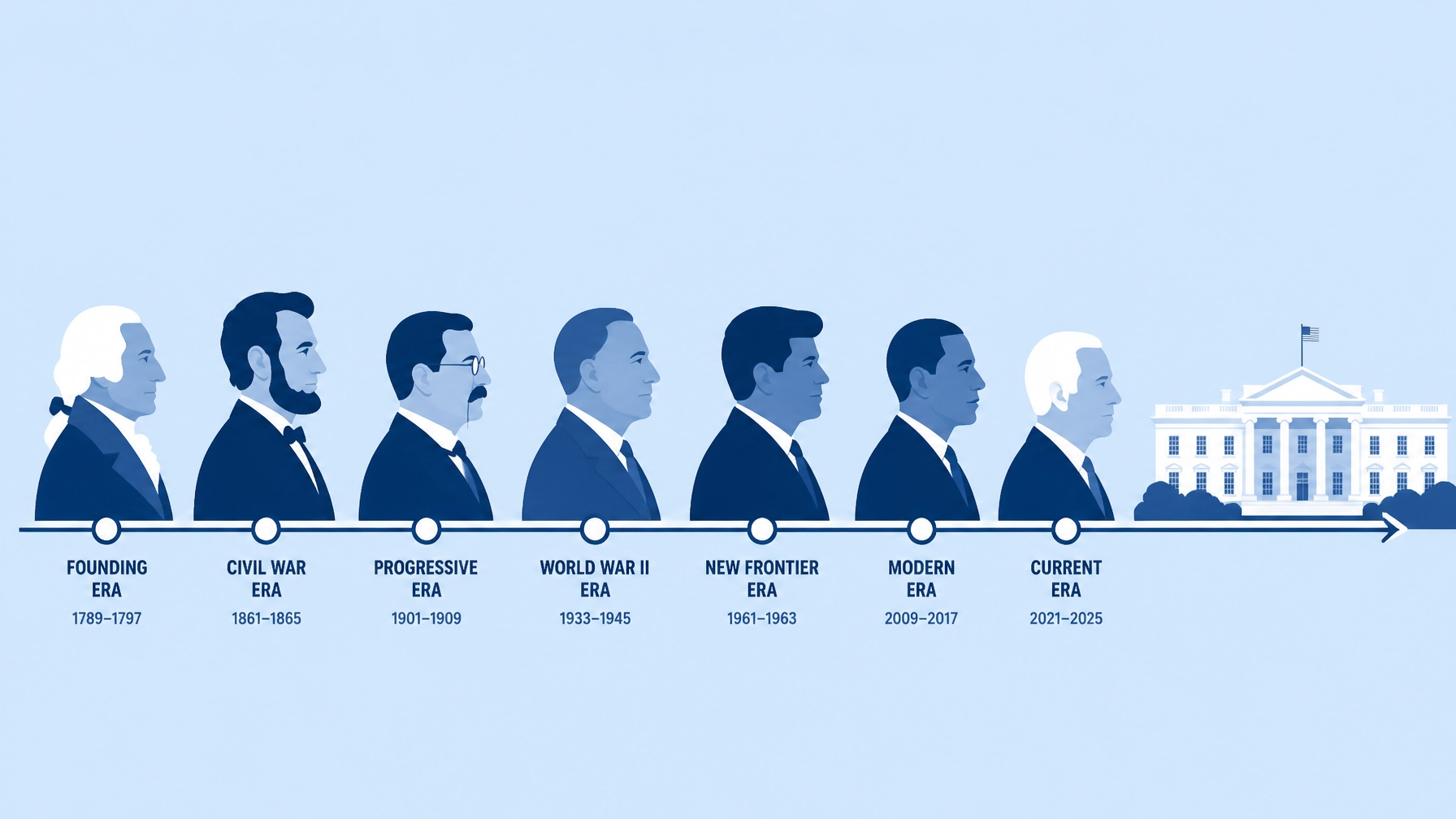
From Washington to Trump, tracing the institutional playbook that built the modern American presidency.
The president of the United States serves as both head of state and head of government, directing the executive branch while acting as Commander:in:Chief of the armed forces. This dual role places the president at the center of American governance, with the power to shape policy, influence legislation, and redefine the relationship between the federal government and the American people. In many ways, the presidency is the ultimate executive franchise, where each chief executive acts as the head coach and general manager of the nation's vast operational roster. Throughout U.S. history, each president has left a distinct mark on the structure and function of government itself, adding new pages to the institutional playbook that governs millions.
The Constitutional Foundation

According to Article II of the Constitution, the president serves a four-year term and is empowered to make treaties and appointments within the federal government (with Senate approval), report to Congress annually on the state of the union, propose legislation, and veto bills. The Founders deliberately refrained from making the presidency a facsimile of the British monarchy, instead creating an executive who had to be both responsive and accountable to the citizenry and balanced against the other two branches of government. They were essentially drafting a league charter that prevented any single franchise from exerting total control over the competition.
The power of the Executive Branch is vested in the president, who leads a vast bureaucracy that has grown dramatically since the nation's founding. When Thomas Jefferson entered office in 1801, the number of federal government workers totaled only 130: a lean startup by any standard. Today, the executive branch employs millions and encompasses dozens of cabinet departments and independent agencies. This massive front office requires a sophisticated organizational structure that the Founding Fathers could scarcely have imagined when drafting the governmental roster.
The Evolution of Presidential Power
The twentieth century brought what has been called the "modern American Presidency." World Wars I and II, the Great Depression, and the Cold War all led to a much larger presidential institution to cope with the nation's new superpower status. Especially following the activist approach that President Franklin Roosevelt took in fighting the Depression and World War II, it was no longer enough for subsequent presidents merely to preside over the nation's fortunes: they needed to actively direct national policy.
This shift represented a total rebranding of the executive franchise. The "modern" era required a leader who functioned less like a referee and more like a high-stakes commissioner, setting the tone for every department. As the federal government took on more responsibilities, from economic stabilization to global security, the president’s "playbook" expanded to include executive orders, signing statements, and a massive support staff within the Executive Office of the President.
Presidential Impact on Government: A Historical Summary
The Founding Era (1789:1825)
George Washington (1789:1797) established the precedent for the presidency itself, creating the cabinet system and demonstrating that the office could be both powerful and restrained. He set the crucial precedent of stepping down after two terms, establishing a tradition that would last until FDR and eventually be codified in the 22nd Amendment. Washington's approach emphasized a strong but limited federal government: the original coaching tree for all future executives.
John Adams (1797:1801) expanded federal authority through the Alien and Sedition Acts, testing the limits of executive power during wartime and sparking the first major debate over federal versus state authority.
Thomas Jefferson (1801:1809) sought to reduce the size and scope of the federal government, proposing to cut the already small federal workforce in half. However, the Louisiana Purchase dramatically expanded federal territorial authority, demonstrating the tension between Jefferson's small government ideals and the practical demands of presidential leadership. He realized that sometimes, to win the long game, a franchise must pursue aggressive league expansion.
James Madison (1809:1817) led the nation through the War of 1812, which tested the young republic's governmental structures and ultimately strengthened federal authority over the states.
James Monroe (1817:1825) presided over the "Era of Good Feelings" and articulated the Monroe Doctrine, establishing a long-lasting framework for American foreign policy and asserting federal authority over hemispheric affairs.
The Antebellum Period (1825:1861)
John Quincy Adams, through James Buchanan, oversaw a period of expanding federal power through territorial acquisition and infrastructure development, even as debates over states' rights intensified. The presidency during this era struggled to maintain federal unity as sectional tensions grew. The executive branch was effectively managing a league that was threatening to split into rival divisions.
The Civil War and Reconstruction (1861:1877)
Abraham Lincoln (1861:1865) fundamentally transformed the presidency and the federal government. His wartime leadership established the precedent that the president could take extraordinary measures to preserve the Union, including suspending habeas corpus and issuing the Emancipation Proclamation. Lincoln's presidency cemented federal supremacy over the states and redefined the federal government's role in protecting civil rights: a mid-season pivot that saved the entire franchise from collapse.
Andrew Johnson (1865:1869) clashed with Congress over Reconstruction, leading to his impeachment and establishing important precedents about the limits of presidential power and congressional authority over Reconstruction policy.
Ulysses S. Grant (1869:1877) used federal power to enforce Reconstruction and protect the rights of freed slaves, though his administration also saw the growth of political patronage that would eventually lead to civil service reform.
The Gilded Age and Progressive Era (1877:1921)
Presidents from Rutherford B. Hayes through William Howard Taft navigated the transition from a limited government to an increasingly active federal state. The Progressive Era presidents: particularly Theodore Roosevelt (1901:1909) and Woodrow Wilson (1913:1921): expanded the regulatory state, established new federal agencies, and redefined the president's role as a national leader who actively shapes legislation and public policy. They introduced the concept of the "bully pulpit," using the presidency to influence public opinion much like a modern sports owner might use media rights to grow their brand.
The Modern Presidency (1921:Present)

Franklin D. Roosevelt (1933:1945) created the modern presidency through his response to the Great Depression and World War II. The New Deal dramatically expanded the federal government's role in economic and social policy, creating dozens of new agencies and programs. FDR's leadership during World War II further centralized power in the executive branch, establishing precedents for presidential war powers that continue to this day. This was the "Championship Era" of governmental growth, where the front office became the dominant force in American life.
Harry S. Truman (1945:1953) institutionalized the Cold War presidency, creating the national security state with new intelligence agencies and a permanent military establishment. He described the president as "the lobbyist for the entire nation," reflecting the office's expanded role.
Dwight D. Eisenhower (1953:1961) expanded federal infrastructure through the interstate highway system and maintained the Cold War consensus while warning about the "military:industrial complex."
John F. Kennedy (1961:1963) used the presidency to advance space exploration and civil rights, demonstrating the office's power to set national priorities and mobilize public support for ambitious goals.
Lyndon B. Johnson (1963:1969) achieved major legislative victories on civil rights and created the Great Society programs, vastly expanding the federal government's role in social welfare.
Richard Nixon (1969:1974) expanded executive power through his "imperial presidency" approach, though his resignation following Watergate led to new constraints on presidential authority.
Ronald Reagan (1981:1989) sought to reduce the size of government while simultaneously strengthening the military and executive authority in foreign policy. His tax cuts and deregulation efforts reshaped the federal government's relationship with the economy, essentially attempting to streamline the front office and return to a more market-driven league structure.
Bill Clinton (1993:2001) presided over welfare reform and budget surpluses, while navigating the tensions between an activist presidency and a Republican Congress.
George W. Bush (2001:2009) expanded presidential power significantly after 9/11, creating new security agencies and asserting broad executive authority in the War on Terror. His education and Medicare reforms also expanded federal involvement in traditionally state domains.
Barack Obama (2009:2017) expanded the federal role in healthcare through the Affordable Care Act and used executive actions extensively in response to congressional opposition, particularly on immigration and environmental policy.
Donald Trump (2017:2021, 2025:present) has pursued an agenda of deregulation, immigration restrictions, and challenges to traditional norms of presidential conduct. His administration claimed significant job growth and increases in middle-class incomes. Trump's approach has tested the constraints on executive power and reshaped the relationship between the presidency and other branches of government, often bypassing traditional media to engage directly with his fanbase.
The Contemporary Presidency

Today, the president takes on a variety of roles that reflect the office's increased powers and prestige. As a legislative leader, the president is often the key figure in determining which bills get passed. The White House crafts and promotes its own legislative agenda, and the State of the Union address is used not only to report on the national situation but also to present the president's legislative priorities to Congress.
As Commander-in-Chief, the modern president has vast power at his disposal, manifested in large military budgets, the presence of American forces worldwide, intelligence-gathering organizations, and nuclear command authority. Presidents travel more extensively and appear before the American people more frequently than ever before, using the "bully pulpit" to shape public opinion and pressure Congress. They are the ultimate franchise players in a global game of diplomacy and defense.
Conclusion

The presidency has evolved from a relatively limited office into the most powerful position in American government. Each president has contributed to this evolution, whether by expanding federal authority, testing the limits of executive power, or reshaping the relationship between the branches of government. The tension between an empowered presidency and the constitutional system of checks and balances remains a defining feature of American governance. As new leaders join the roster and draft their own institutional playbooks, the debate over presidential power will continue to shape the nation's political development for decades to come.
Mark Ricci is a senior political correspondent covering federal governance, policy, and institutional affairs for USGov.News.


