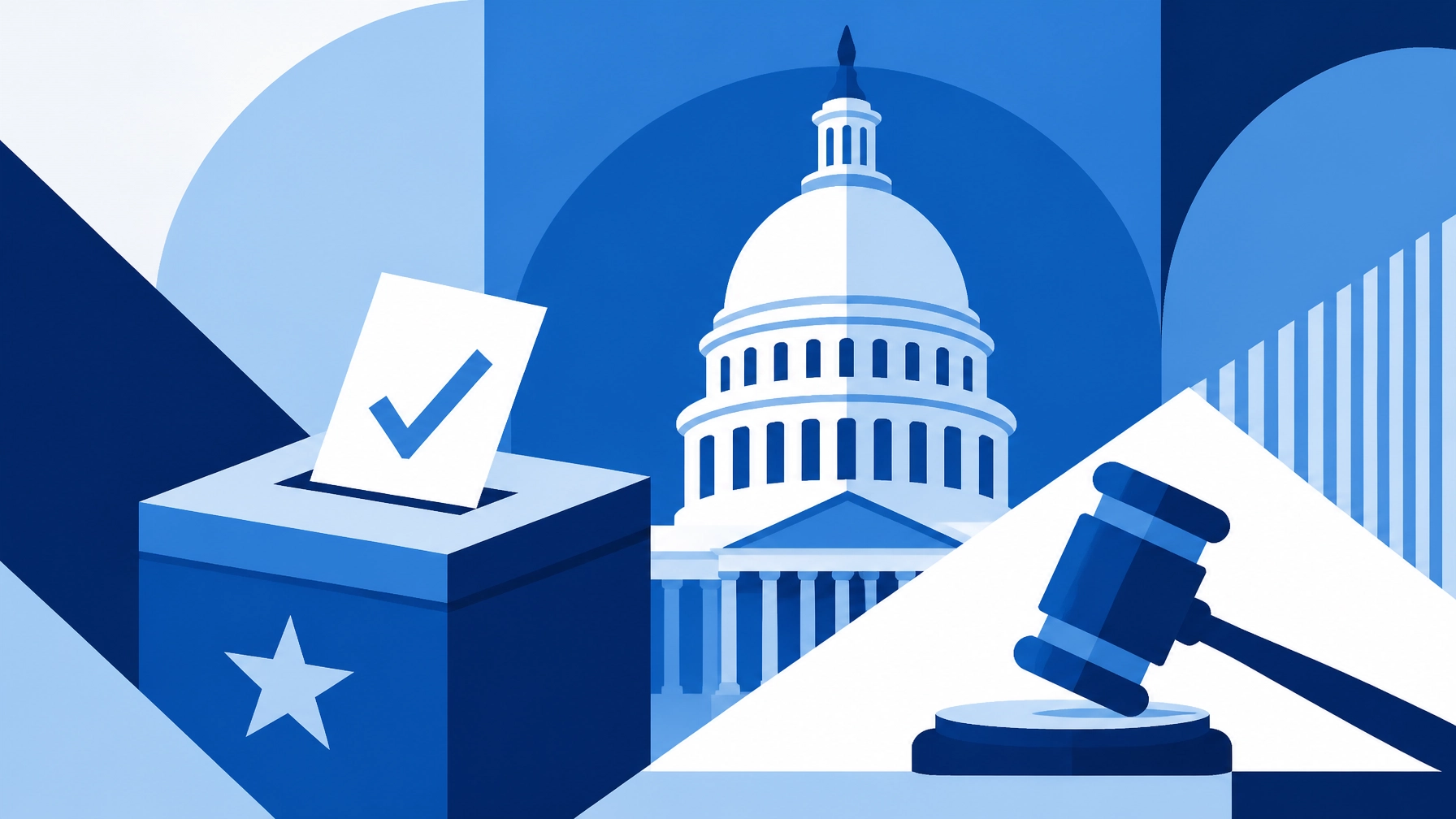
WASHINGTON: A single day in mid-July: A single day in mid-July 2026 offered a sharp illustration of the pressures bearing down on U.S. democracy, as battles over election rules, war funding, and civil rights converged into a portrait of a political system under strain. From President Donald Trump’s primetime address to congressional fights over voting and Iran, the events of July 16 highlighted how questions of legitimacy and power are now central to American politics.
As the nation moves toward the 2026 midterm championship season, the institutional playoffs are already in full swing. The political maneuvers observed throughout the day suggest a league front office deeply divided over the basic rulebook of governance. Analysts at USGov.News noted that the convergence of foreign conflict and domestic policy debates has created a high-stakes environment where every legislative play is scrutinized for its long-term impact on the franchise of American democracy.
A Nation Debating the Rules of Democracy
Rather than just another campaign speech, President Trump’s primetime address on July 16 underscored how the basic rules of U.S. democracy have become a central political battleground. Speaking from the White House, the ultimate home turf, the President treated election administration itself as a matter of national security and partisan identity. By casting U.S. elections as vulnerable to manipulation and urging Congress to pass new restrictions, the administration is effectively rewriting the defensive playbook for the upcoming electoral cycle.

The clash was not simply over policy details, such as voter ID requirements or mail-in ballot rules, but over public trust in the system. Courts and election officials have repeatedly affirmed that there is no evidence of widespread fraud changing the outcome of the 2020 race, yet Trump’s decision to revive those claims signaled that fights over legitimacy will remain a defining feature of the 2026 campaign season. This "SAVE America" pitch aims to tighten league rules, with the administration claiming that the current infrastructure catastrophically falls short of preventing interference.
According to reports from USGov.News/articles, the President also announced the declassification of intelligence files related to the 2018 and 2020 cycles, alleging foreign attempts to undermine his previous campaigns. While critics argue these claims lack context, the move serves as a "clutch" play to energize a fanbase concerned with national sovereignty. The administration’s focus on "election integrity" is now the primary strategy being run out of the executive locker room.
Congress Caught Between War and the Ballot Box
On Capitol Hill, the tension between governing and campaigning was on full display. House Republicans advanced a sweeping budget plan tied to the ongoing war with Iran that would also pave the way for new election restrictions. This fusion of foreign policy and domestic rule-making represents a complex, multi-layered scrimmage for control of the federal purse.
The $1.5 trillion defense budget proposal has hit a wall of legislative defense. The same bill that bankrolls military operations in the Gulf, including the recent expansion of strikes into northern Iran, also moves forward measures drawn from Trump-backed voting proposals. This strategy has blurred the line between the "war room" and the "polling station," deepening Republican splits over the cost, scope, and timing of these initiatives. Some lawmakers see this as a necessary play to project strength; others in the caucus warn it risks a massive turnover in closely contested districts.

Furthermore, the 60-day War Powers clock has reportedly resumed, putting additional pressure on the legislative front office to finalize funding. The "guardians of the Hormuz Strait" narrative is being leveraged to justify a $95 billion reconciliation package, though internal divisions over aid to Israel continue to complicate the lineup. For a detailed breakdown of these legislative maneuvers, readers can visit the USGov.News press releases section for the latest updates from the Hill.
Courts Redrawing the Democratic Landscape
Even as the political branches sparred, the courts, acting as the ultimate referees, continued to reshape the legal framework around democracy. A recent Supreme Court decision weakening Section 2 of the Voting Rights Act in a Louisiana redistricting case signaled a narrower view of federal protections against discriminatory maps. This ruling effectively changes the boundaries of the playing field just as the 2026 season begins.

Civil rights advocates warned that this decision, combined with new state laws and federal proposals like the SAVE Act, could make it easier for states to dilute the power of voters or impose restrictive rules under the banner of “integrity.” The judicial bench is essentially recalibrating the strike zone for what constitutes an "allowable" voting map.
At the same time, the Court’s affirmation of birthright citizenship on June 30 reaffirmed one of the most fundamental principles of the league, fueling fresh debate over who belongs and on what terms in the modern United States. These rulings demonstrate that the judicial branch is not sitting on the sidelines; it is actively interpreting the rulebook in ways that will determine the outcome of the midterms and beyond.
Money and Influence in the Campaign Arena
Long-running concerns about money in politics also resurfaced around July 16. The Washington State Supreme Court’s decision to uphold a $35 million fine against Meta for campaign-finance disclosure violations reinforced the idea that states can still play an aggressive role in policing digital political ads and ensuring transparency. Even as federal enforcement remains uneven, this state-level penalty serves as a yellow card for major tech franchises attempting to bypass transparency rules.

Nationally, new filings showed Republicans leaning more heavily on super PACs and wealthy donors as traditional party committees and many individual campaigns struggled with cash flow. This imbalance in "franchise capital" has deepened worries that a shrinking pool of mega-donors is wielding outsized influence over which candidates get a platform and what issues dominate the airwaves.
The reliance on high-net-worth boosters has created a "salary cap" issue for grassroots candidates, who find themselves priced out of the advertising market. This shift in how campaigns are financed is altering the recruitment process for new political talent, favoring those with existing connections to the league's major financiers. Subscribers to our newsletter receive weekly analysis on how these financial trends are impacting the 2026 scoreboard.
A System Under Stress
Taken together, the events of July 16, 2026, did more than fill a single news cycle. They exposed the extent to which core democratic mechanisms- how elections are run, who draws the maps, who pays for campaigns, and how war powers are funded- are now contested terrain. The institutional stadiums of American governance are under more pressure than at any point in recent memory.
As the 2026 midterms approach, the central question is no longer just which party will win, but how the rules themselves will be written and interpreted. The "post-game" analysis of July 16 suggests a nation bracing for a highly contentious championship run. Whether the system can absorb these stresses without further eroding public trust will be the key test for American democracy in the months ahead. The coaching staff on both sides are preparing for a "two-minute drill" that will determine the direction of the country for years to come.
Mark Ricci is a senior Journalist covering federal governance, policy, and institutional affairs for USGov.News.