


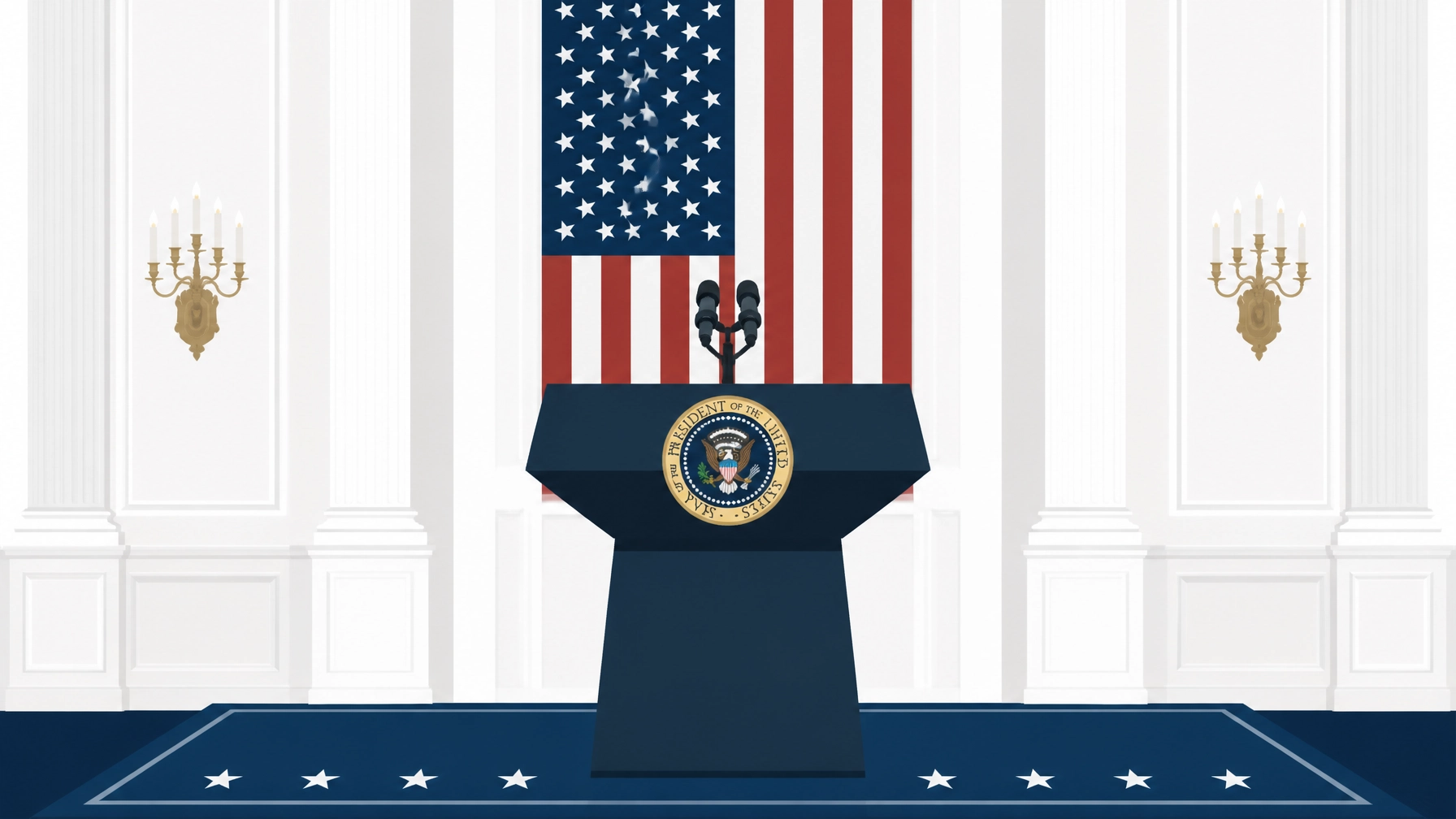
President Trump uses a rare national address to claim newly declassified documents expose election vulnerabilities, reigniting debates over election integrity amid Iran tensions and midterm campaigning.
WASHINGTON, D.C.: July 17, 2026
By Mark Ricci
U.S. politics on July 16, 2026, were dominated by President Donald Trump’s rare primetime address on election security and foreign influence. The speech reignited long-running disputes over the legitimacy of past elections even as tensions with Iran and other global flashpoints continued to demand attention. The address, delivered from the East Room of the White House, marked a significant pivot in administration messaging as the 2026 midterm elections approach.
Trump's Primetime Address on Elections
Speaking from the White House, President Trump used the nationally televised address to make elections and “integrity” the central theme of the night. He warned that the U.S. voting system “falls catastrophically short” of preventing cheating. He argued that “no country can be great without fair and honest elections,” framing stricter voting rules as a prerequisite for American greatness.
The President was flanked by Vice President JD Vance and Secretary of State Marco Rubio, signaling that the administration views election security as a top-tier national security priority. During the 25:minute speech, Trump announced the release of what he described as previously classified documents related to the 2018 and 2020 elections. He claimed these files showed foreign powers, especially China, had tried to undermine his campaigns.
As the President spoke, the White House unveiled a website that hosted selected investigative files, intelligence analyses, and internal correspondence. These materials were presented as evidence of vulnerabilities in voting machines and election infrastructure. Trump specifically cited an allegation that Chinese actors had compromised 220 million U.S. voter files, including names, addresses, and party preferences. This claim echoes previous reports that the U.S. Treasury Department says it was hacked in a China-linked cyberattack, though the scale of the alleged data breach cited on July 16 significantly exceeds prior estimates.
Fact-Checkers and Critics Challenge His Claims

Nonpartisan fact-checkers and intelligence experts swiftly disputed Trump’s implications that foreign actors had changed the outcome of the 2020 election. Previous government assessments have found no credible evidence that votes were manipulated or that foreign interference altered the final results. This remains true even though Russia, China, and other adversaries attempted information operations and influence campaigns.
Analysts noted that many of the documents released lacked context. They did not demonstrate that ballots were changed or tallies hacked, despite Trump’s rhetoric suggesting “dangerous exposure” to foreign tampering. The Cybersecurity and Infrastructure Security Agency (CISA) has previously maintained that U.S. election systems are resilient due to diverse technologies and paper trail requirements.
Democratic lawmakers accused the President of reviving false claims of stolen elections. They argued the move was intended to cast doubt on the upcoming 2026 midterms and justify a push for stricter voting rules. Rep. Hakeem Jeffries (D: NY) stated that the administration was "cherry:picking intelligence" to create a narrative of systemic corruption where none exists. The timing of the speech was also noted by legal experts, occurring as various federal positions remain in flux, similar to when the DC US Attorney was set to step down days before the Trump inauguration.
Push for New Voting Laws

Trump’s address doubled as a sales pitch for tougher federal voting legislation. He specifically promoted the "SAVE America Act," a bill designed to mandate strict voter ID requirements and limit the use of electronic voting systems. He argued that Congress must act to tighten rules on mail-in ballots and voting technology, portraying these changes as necessary to restore public trust.
The proposed legislation includes provisions requiring proof of citizenship for all federal elections. It also seeks to phase out certain types of electronic ballot-marking devices in favor of hand-marked paper ballots. The administration has framed these measures as "common:sense protections."
However, the Associated Press and other outlets noted that the bill he referenced has stalled in Congress. It lacks sufficient support even among some Republicans who are wary of revisiting unfounded fraud narratives. Some GOP strategists have expressed concern that focusing on 2020 may alienate swing voters who are more concerned with current economic issues. The legislative stalemate highlights deep divisions within the party over how to address election integrity issues ahead of November.
Iran and Foreign Policy in the Background

Although Trump’s speech centered on elections, it took place against a backdrop of escalating tensions with Iran. The administration is currently managing a fragile ceasefire and ongoing indirect talks over the Strait of Hormuz and broader regional security. News outlets highlighted that the same administration pushing new election rules is also managing an active conflict environment in the Gulf.
U.S. bases in the region have recently come under fire from Iranian-backed militias, and diplomacy remains uncertain. The conflict, which the President once suggested could be resolved quickly, has become a prolonged engagement. Foreign policy analysts noted the stark contrast between the President's focus on domestic voting procedures and the deteriorating situation in the Middle East.
While the speech did not announce new military actions, Secretary Rubio's presence was interpreted by some as a signal that the administration remains focused on global adversaries. Commentary in major newspapers framed July 16 as a day when Trump “railed against election systems and familiar enemies” while the Iran war “escalates further.” This underscores how domestic and foreign crises are intertwined in the current political moment.
Media and Public Reaction

Media coverage emphasized the contradictions in Trump’s message: a twice-elected president using the bully pulpit to attack the legitimacy of a system that twice put him in office. Major broadcast networks such as ABC, NBC, and CNN did not carry the speech live on traditional TV. Instead, they aired it in full on their streaming platforms. This decision underscored both the political sensitivity of the address and the changing media landscape.
Critics said the speech risked further eroding trust in democratic institutions. Supporters praised it as long overdue transparency on election security. Polling conducted immediately following the address showed a sharp partisan divide in how the information was received. Republican-leaning voters largely expressed concern over the "declassified" vulnerabilities, while Democratic-leaning voters viewed the speech as a campaign stunt.
With all House seats and 35 Senate seats on the ballot in November, Trump’s July 16 address is widely seen as a centerpiece of Republican messaging for the 2026 midterms. The administration is tying “election integrity” to broader narratives about national strength and sovereignty. The full political impact remains to be seen, but both allies and opponents agree that the speech has raised the stakes in an already high-tension election year.
Mark Ricci is a senior journalist covering federal governance, policy, and institutional affairs for USGov.News.


